Exhibition: Subverting the Gaze
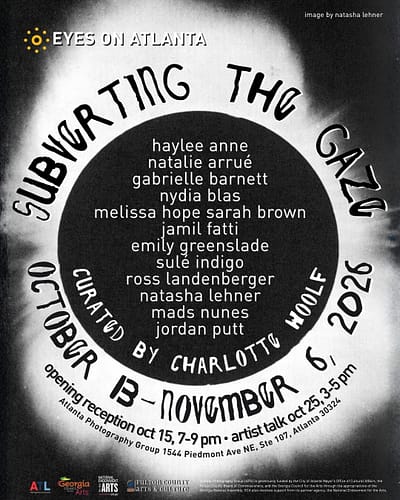
Date(s) - 10/13/2026 - 11/06/2026
Time(s) - 10:00 am - 4:00 pm
Time(s) - 10:00 am - 4:00 pm
Location
Atlanta Photography Group
Eyes on Atlanta: Subverting the Gaze
The Atlanta Photography Group is excited to present the next installment in our Eyes on Atlanta series. For this exhibition, we are featuring the works of 12 Atlanta artists, selected by curator, Charlotte Woolf, Assistant Professor of Studio Art, Georgia State University.
Participating Artists
Haylee Anne
Natalie Arrué
Gabrielle Barnett
Nydia Blas
Melissa Hope Sarah Brown
Jamil Fatti
Emily Greenslade
Sulé Indigo
Ross Landenberger
Natasha Lehner
Mads Nunes
Jordan Putt
Event Dates
Exhibition:
October 13 – November 6, 2026
In-Person Open House/Reception
Thursday, October 15, 2026, 7-9pm ET
In-Person Artist Talk
Sunday, October 25, 2026, 3-5 ET
APG Gallery at Ansley Mall
1544 Piedmont Ave NE, #107, Atlanta, GA 30324
Located between LA Fitness and CVS Pharmacy
Show Statement
Eyes on Atlanta: Subverting the Gaze, curated by Charlotte Woolf, explores the ways artists challenge, complicate, and reclaim systems of looking that have historically shaped how people are represented and understood. While the concept of the gaze is often associated with the male gaze, a term film theorist Laura Mulvey introduced in the 1970s, the idea has expanded to examine broader relationships among power, visibility, and representation.
Building on and challenging existing conversations around the gaze, bell hooks introduced the concept of the oppositional gaze, a critical, resistant way of looking that recognizes systems of power. Her work examined how Black women were often excluded from dominant conversations around representation and expanded feminist theory through an intersectional lens. The oppositional gaze recognizes that looking is not passive, but a way of engaging with, questioning, and challenging the images and narratives created within systems of power.
This exhibition considers the many gazes that artists may choose to subvert, including but not limited to the male gaze, white gaze, colonial gaze, cis gaze, Western gaze, and medical gaze. Through photography and related practices, artists challenge the power dynamics inherent to the camera itself, question cultural expectations around beauty and identity, and take the depiction of self into their own hands.
Subverting the gaze can take many forms. It may mean disrupting familiar ideas of who is worthy of being seen, challenging the expectation that a photograph of a person must function as a traditional portrait, or creating images that resist easy interpretation. Abstraction, fragmentation, and alternative forms of representation can also become acts of subversion by refusing familiar ways of seeing.
At its core, Subverting the Gaze asks: Who is looking? Who is being looked at? Who controls the image? And what possibilities emerge when artists challenge the systems that have historically shaped visibility and representation?
 Charlotte Woolf
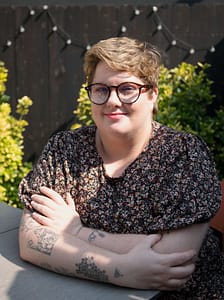
Charlotte Woolf (she/they) is a queer artist, educator, and curator whose work explores infrastructure, labor, and land through photography and community engagement. Their practice is informed by a background in gender studies, and their recent series, Expanding Agriculture, highlights sustainable farming and food justice through collaborations with women and LGBTQIA+ growers.
Woolf holds an MFA from SUNY Purchase and a BA from Kenyon College. She has exhibited at A.I.R. Gallery, Army of Frogs, Atlanta Art Fair, the International Center of Photography, Paradice Palase at Future Fair, and Spring/Break Art Show. Her residencies include ACRE (IL/WI), SOMA (CDMX), Wassaic Project (NY), and ChaNorth (NY), and she received an Honorable Mention for the Lenscratch Student Prize. Since 2022, she has curated exhibitions at Foxtrot Farm & Flowers during Upstate Art Weekend, organizing readings, tattoo pop-ups, performances, and community events exploring queer ecology.
Woolf is an Assistant Professor of Studio Art at Georgia State University Perimeter College, where she also serves as the Faculty Curator, recent shows include Alphabet Redacted: LGBTQIA+ Photographers of Atlanta and You are not alone: BUGS!
They live with their wife, cat, and two black pugs named Peach and Blueberry Cobbler in Atlanta.
Artist Biographies
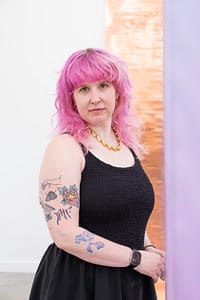 Haylee Anne
Haylee Anne is a disability-centered artist and creative practitioner. She holds a BFA from Montclair State University and a MFA from Georgia State University. Her work has shown at venues including the Atlanta Center for Photography, the Center for Civil and Human Rights, Torpedo Arts Center, Soho20 Gallery, the CICA Museum, the Kyoto Shibori Museum, and the 2026 Wiregrass Biennial. Her honors include the VSA Excellence in Artistry Award from the Smithsonian and the Kennedy Center (2013), a distinguished fellowship at the Hambidge Center for Creative Arts and Sciences (2020), the Winne Chandler Art & Design Scholarship from Georgia State University (2023), the Filter Photo Festival Scholarship (2024), the Anderson Ranch Workshop Scholarship (2025), the El Columpio residency with The Creatives Project (2025), the Corinne Adams Emerging Artist Fellowship from the Atlanta Center for Photography (2026), and the Uncool Artist International Residency (2026). An enthusiastic collaborator, Haylee’s practice emphasizes expansive, empathetic impact. She lives and works in Atlanta, GA, alongside her three cats: Jude, Jonah, and Jimmy.
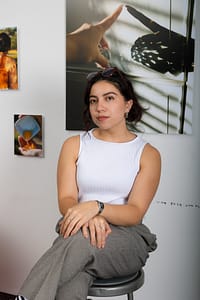 Natalie Arrue | nataliearrue.com | @nataliearrue
Natalie Arrué (she/her) is a lens-based artist located in Metro-Atlanta, Georgia. Her work reflects on identity, memory, and place through the eyes of her Salvadoran heritage and personal upbringing. As a first-generation Salvadoran American, she collaborates with her family and their photo archive, weaving together generational narratives, religious symbolism, and staged rituals to explore the tension between inheritance and self-definition. Through intimate portraits and quiet performances, her work meditates on childhood memory, spirituality, and the role of women as cultural preservers, examining how tradition lives in the body and how faith, performance, and identity intertwine.
Natalie earned her BFA in Photography from the Ernest G. Welch School of Art & Design at Georgia State University. Her work has been exhibited in Eyes on Atlanta: Contemporary Latinx Photography at the Atlanta Photography Group Gallery and The Curated Fridgein Boston. Her work has been featured in The New York Times and Lenscratch, as well as published in La Horchata Zine, New South: Reciprocity, andThe Underground Journal.
 Gabrielle Barnett | gabriellejbarnett.com | @gabrielle_jbarnett
Gabrielle Barnett (she/her) is a Louisiana-based artist and educator working primarily in photography and video. Her work explores fatness, body image, motherhood, desirability, and the ways bodies are seen and understood. Drawing from personal experience, Barnett often uses her own body and everyday situations to examine larger ideas around visibility, shame, care, and belonging.
Barnett received her MFA in Photography from the University of Georgia’s Lamar Dodd School of Art in 2025. Her work has been exhibited nationally and internationally and has received recognition including First Prize at FELT Summer Contemporary and selection as a Photolucida Critical Mass finalist and Rising Star Grant recipient. Her work has also been exhibited at the International Photography and Media Art Festival in Lithuania.
In addition to her studio practice, Barnett teaches photography, video, digital media, and visual arts. She currently lives and works in Louisiana.
 Nydia Blas | nydiablas.com | @neeksiebeeks
Nydia Blas (she/her) is a visual artist who grew up in Ithaca, New York and currently resides in Atlanta, Georgia. She holds a B.S. from Ithaca College and received her M.F.A. from Syracuse University in the College of Visual and Performing Arts. She is an Assistant Professor in the Department of Art and Visual Culture at Spelman College in Atlanta, Georgia. Nydia is a 2026 recipient of the Creative Capital State of the Art Prize in Visual Arts. Her work has been commissioned by The New York Times, New York Magazine, The New Yorker, Time Magazine and more. She has completed artist residencies at Constance Saltonstall Foundation for the Arts, The Center for Photography at Woodstock, and Villa Albertine in Marseille, France.
Nydia uses photography, collage, video, and books to address matters of sexuality, intimacy, and her lived experience as an American girl, woman, and mother of Afro-Panamanian descent. She delicately weaves stories concerning circumstance, value, and power and uses her work to create a physical and allegorical space presented through a Black feminine lens.
Love You Came from Greatness is the first major monograph by American photographer Nydia Blas, it is an exploration of one Ithaca-based Black family and its community across many generations. The book is also a formally rigorous examination of the taxonomy and syntax of family portraiture.
Blas’ contemporary works are integrated with selections from her historical family albums in order to tell an extended intergenerational story, and to bring forward the evolving and recurring nature of the portrait photograph throughout the medium’s history. Deploying doubling, repetition, and more subtle echoing and mirroring, Love, You Came from Greatness builds a powerful line of feeling and thought across generations and photographic tropes and styles.
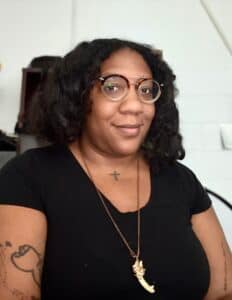 Melissa Hope Sarah Brown | MHSBphotos.com | @melissa.hope.sarah.brown
Melissa Brown is a photographer and visual storyteller based in Statesboro, Georgia. She graduated from the Savannah College of Art and Design in 2014 with a degree in photography and is currently pursuing her Master of Fine Arts at Georgia Southern University. Her work explores themes of identity, race, and community through Black-and-white documentary and portrait photography.
Brown is increasingly exploring Afro-surrealism as a means of navigating existence and the lived experiences of inhabiting a Black, feminine body in the American South. Her photography captures intimate moments that reflect the resilience, vulnerability, and beauty of the human experience. As a contributor to the Georgia Historical Society, she merges artistic expression with archival precision, preserving the complexities of the past while connecting them to the present.
Deeply informed by her experiences as a Black woman in the South, Brown’s practice engages with themes of self-preservation, memory, and emotional depth. Her layered visual narratives invite viewers to reconsider the histories and experiences that shape individual and collective identities.
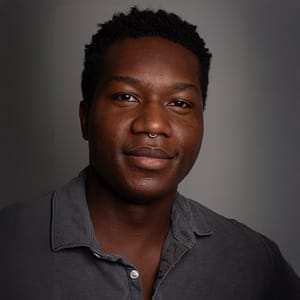 Jamil Fatti | jamilfatti.com | @jamilfatti
Jamil Fatti (he/him) is a Gambian-American artist working primarily in photography. His work traces impermanence and memory, exploring how cycles of time, transition, and loss shape our search for meaning. Across recent bodies of work, his photographs move between outward attention and interior rupture. He looks closely at the visible world while tracing the pauses, uncertainties, and emotional weather that shape a life from within.
His work has been exhibited internationally and across the United States, at venues including the Atlanta Contemporary Art Center, Microscope Gallery in New York, Filter Space in Chicago, Trastienda Machete Galeria in Mexico City, and Millepiani Gallery in Rome. His work is held in public and private collections, including the RISD Museum, and has been featured in publications including The New York Times, Atlanta Center for Photography’s New South, and Float Magazine. He holds a Master of Fine Arts from the Rhode Island School of Design (RISD) and degrees in Landscape Architecture and City/Regional Planning from Cornell University.
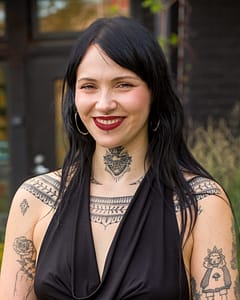 Emily Greenslade | emilyannegreenslade.com | @boneyardgrl
Georgia-based photographer Emily Greenslade (She/Her) creates self-portraits within the themes of fetishism, pin-up, vaudeville, and historical processes. She has been showcased in multiple exhibitions with Atlanta Photography Group, Bellows Film Lab, and Texas Photographic Society. Greenslade previously attended Parsons School of Design but completed her Bachelor of Fine Arts at Kennesaw State University. She is now pursuing a Master’s in Museum Studies at Kennesaw State University.
Irving Klaw’s Classics (Vol. I-IV), Light it: Vydia Swan Lighters, and Cigarette Case reflect an ongoing portfolio that combines nostalgic objects with caricature. The presence of Vydia Swan in everyday items challenges ideas of what art is and where it can exist by promoting ‘low-brow’ artifices and a pinup revival.
Wallet Gear is a photographic, mixed-media body of work that explores voyeurism and fetishism in an uncertain social landscape. A wallet is an object exposed daily through routine, mundane rituals; it is meant to carry personal items such as identification and currency, but it can also house explicit keepsakes for the thrill of it. Wallet Gear stimulates the adrenaline of ‘getting caught’ while also bearing its contents through a fine-art lens.
Perfect Match, Babbette’s Bordello is a mixed-media project reimagining a nineteenth-century product: small, thin, tapered candles sold in matchboxes, infamously known as brothel timer matches because of the beautiful women depicted on them. Although no historical evidence suggests they were used this way, the story remains cemented in history and reflects the passage of time and mythmaking.
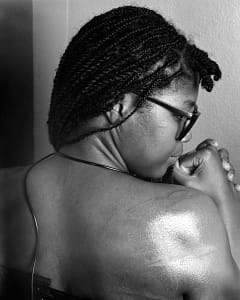 Sulé Indigo | tumblr.com/suleindigo | @suleindigo
Sulé Indigo (they/she) creates self portraits that contemplate the individual and macrosocial consequences of the photographic medium’s history with images of Black femininity and queerness. Re-appropriating ethnographic compositional tropes, pop culture depictions of Black women, and pertinent ephemera like hair, jewelry, and product packaging. They create physically hedonic self portraits, demanding their body be interacted with as the author of its own image. Her work captures the intense dialogue between photographer, subject, and viewer.
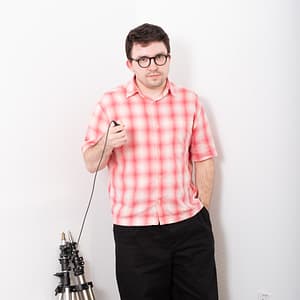 Ross Landenberger | rosslandenberger.com | @rosslandenberger
Ross Landenberger (he/him) is an artist working primarily in photography who was raised in Oak Ridge, Tennessee. Currently based in Atlanta, Georgia, he is a recent MFA graduate in Photography from Georgia State University’s Ernest G. Welch School of Art & Design. His images have been featured in The New Yorker, Financial Times, and on NBC News and have been published in books by Hoxton Mini Press, Routledge, Atlanta Center for Photography, and West Virginia University Press. Recent solo exhibitions include 5 Mountain Dews at THE END Project Space and To Snare the Sun at Gallery 72.
Growing up queer around skateboarders, it was apparent that as a subculture they opposed many aspects of tradition and popular culture. Skateboarders support alternative timelines. They are not living for birth, marriage, reproduction and death. From my observation, skateboarders are living for something other than longevity; they are living with the urgency of now in mind. Skateboarders, much like queer people, are living a life unscripted by tradition. However, skateboarders fail to support this comparison because of the ingrained homophobia and sexism within the sport. Queer Skateboarding documents this intersection in hopes of empowering marginalized people, to show them that they are not alone in trying to carve out a place for themselves in an activity or subculture that was created without them in mind.
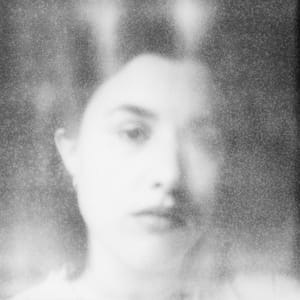 Natasha Lehner | natashalehner.com | @tashwl
Iron Sights examines the parallel histories of photography and weaponry through the use of archival tactical training manuals and photographs made at the Women of Steel and In Her Piece women’s gun clubs in North Carolina. Together, these materials interrogate the larger history of photography, the power of visibility and the positioning of women within contemporary dialogues of self defense. Drawing inspiration from French astronomer Pierre Janssen’s pioneering invention the photographic revolver, Iron Sights emphasize the anatomical similarities between camera and the gun. The 1874 transit of Venus, documented by the photographic revolver, becomes the throughline for Iron Sights as Venus crosses the sun, she resembles the site alignment of a gun while also representing a larger transfer of power and transformation.
Natasha Lehner (b.1998) is a photographer and educator from Pound Ridge, NY. She holds a BFA in Graphic Design and Photography from Belmont University (2020) and an MFA in Experimental and Documentary Arts from Duke University (2024). She currently resides in Macon, GA where she is the Assistant Professor of Art at Wesleyan College. Her work has been exhibited at venues including the Southeastern Center for Photography, Cassilhaus, Greensboro Project Space, SRO Gallery at Texas Tech University, McCrary Gallery at Wesleyan College, Koehane-Kenan Gallery at Duke University and Leu Art Gallery at Belmont University. Most recently, Natasha was named the Lenscratch Photography Educator of the month.
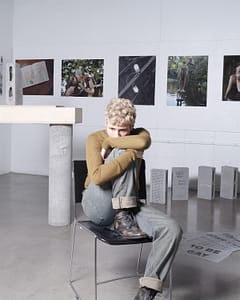 Mads Nunes | www.madisonnunes.com | @madison_ _nunes
Mads Nunes (They/He) is an artist and educator making work in the South of the so-called United States. Interested in the liminal spaces of identity and the socio-geographic components of alternative relational structures, Nunes’s ethnographic practice utilizes photography, installation, and performance to collapse and expand what is often unallowed to exist in a nuanced, shifting light. Their work has received support from Atlanta Center for Photography, South Arts, Idea Capital, Atlanta Photography Group, The Creatives Project, Midwest Nice Art, the Atlanta Mayor’s Office of Cultural Affairs, and Georgia State University where they are a 2026-2028 Welch Award recipient and an MFA candidate. Mads holds a BFA from The School of Visual Arts in New York, where they split their time. They are available for commissions and assignments worldwide. Please direct inquiries to: madison.nunes@gmail.com
It’s All a Song Here utilizes the archive-generating systems of photography to explore power dynamics, ties to the land, diasporic tendencies, and the adaptations of tradition and folk lore that give definite shape to Southern Queer as an identity within the LGBTQ+ lexicon. Despite the South having the highest concentration of LGBTQ+ people in the nation, Southern Queer is often inseparable from migratory periods in metropolises that hold a reputation as havens, both in the eye of American culture at large and in the individual lived experiences of Southern Queer people. Within the work, moments of obfuscation and frustration provide an opportunity to consider whom and what has access, portraits frequently signify performance as a site of collaboration and community, while the land is both a site of healing and a boundary where assumptions are challenged. Generated from transcribed interviews with collaborators, installative references evoke locations of cruising and connection to both block and permit more intense privacy.
If this project feels aligned with you, please get in touch to participate.
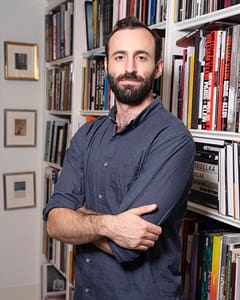 Jordan Putt | Jordanputt.com | @jputtphoto
Jordan Putt is a photographer and educator whose work responds to issues of place, identity, and community. He earned a BA in Psychology from Northern Arizona University, and an MFA in Photography from Columbia College Chicago. His work has been exhibited in the Tucson Museum of Art (Tucson), Filter Space (Chicago), House of Lucie (Los Angeles), and The Goat Farm (Atlanta), among others. He was a 2022 recipient of the Research and Development Grant from the Arizona Commission on the Arts and a 2023 finalist for the Lucie Photo Book Prize. Recent publications include his first monograph, Field Book (Composit Press, 2025), as well as New South, Volume II: Double Vision (Atlanta Center for Photography, 2025) and Oh! Chicago! (No-Type Magazine, 2026). Previously, Jordan has held positions at the Museum of Contemporary Photography in Chicago, the Sir Elton John Photography Collection, and Georgia State University. Jordan is currently based in Athens, GA, where he serves as an Academic Professional Associate and faculty in Photography and Expanded Media at the University of Georgia.
Pageantry of the Damned is a series that focuses on male-dominated outdoor gatherings across the American South. From Civil War reenactments to outdoor fishing gatherings, motorcycle rallies, mudding events and BMX festivals, the images often remove the men from the context of the crowd, posing them alone in the dense terrain. These portraits are contrasted with photographs of the entire group, drawing on the tableau as a form in which collective action and communal identity briefly coalesce. Fragile and nearly consumed by the encroaching flora, the men echo some of the male archetypes of Southern Gothic fiction: the decaying patriarch, the haunted veteran, the lonely drifter. The landscape, overgrown and symbolic of a troubled past, serves as an apt stage for our collaborative portraits. As I reckon with the narrow, destructive models of masculinity amplified by many prominent male figures and social media algorithms, this work addresses these shifting definitions of virility that remain rooted within America’s landscape